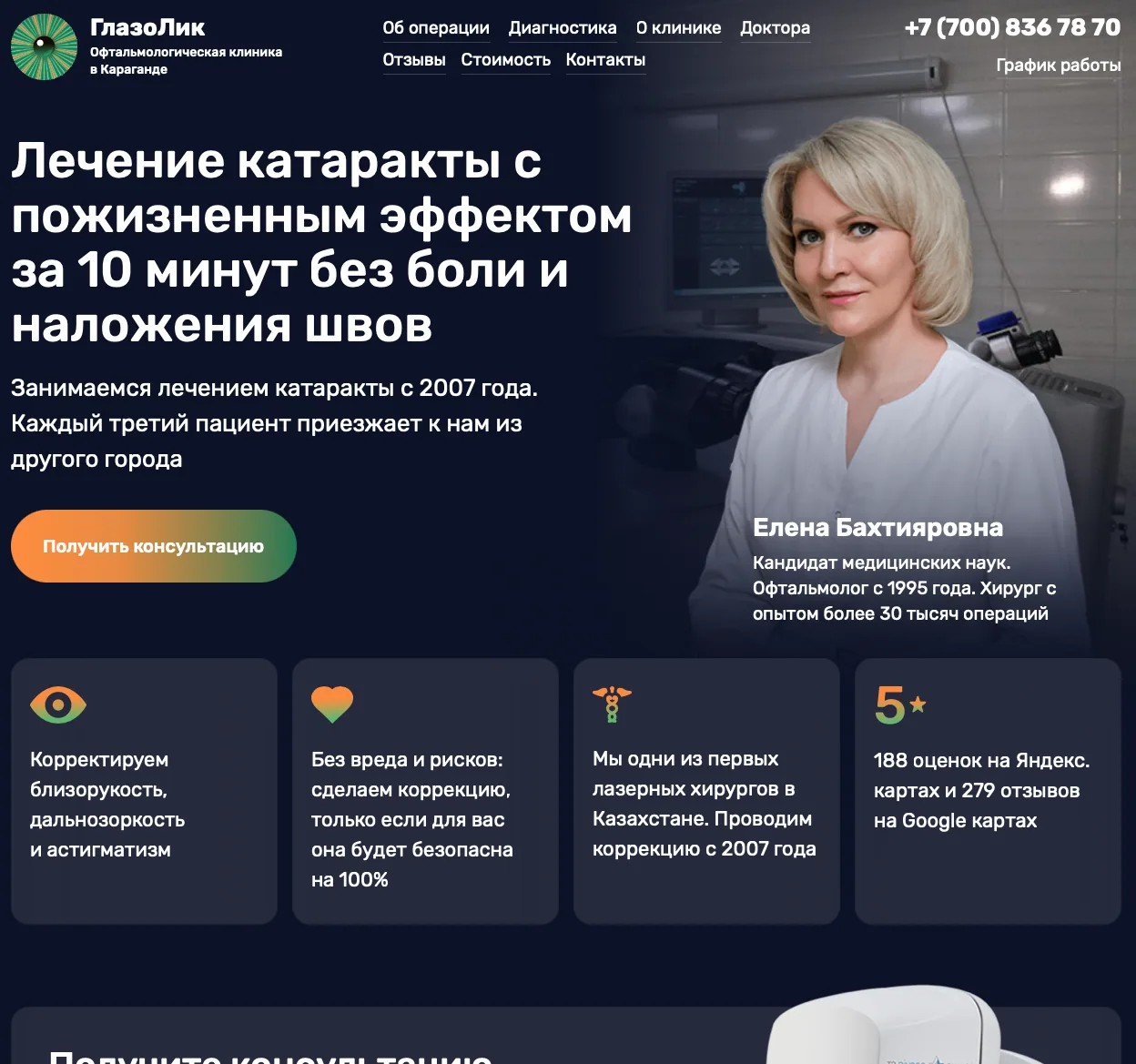
We started working with Glazolik when paid search advertising for ophthalmology did not exist in Karaganda. Google searches for “vision correction”, “ophthalmologist” and “cataract” showed no ads from any clinic. There were no reference points, benchmarks or other people’s experience to draw on. Explaining why a clinic should invest in a channel nobody in the region used was, to put it mildly, a challenge.
The first budget was 30 000 tenge a month. Today, it exceeds 2 million. This growth did not come from the clinic deciding on its own to spend more. It came from eight years of work in which we justified every increase with figures: spend, appointment bookings, operations and revenue. Without that link, the budget would not have grown by a single tenge.
Between the first 30 000 ₸ and today’s two million lie eight years of work, much of which had little to do with advertising itself.
We started with data
First, we helped the clinic move from paper registers to digital records. This might look like a side task unrelated to marketing. In reality, all subsequent advertising would be pointless without it: when appointments are recorded in notebooks, there are no figures to show whether ads work or where money is being lost.
We developed a custom CRM specifically for ophthalmology, from patient profiles and visit histories to surgical logs. We designed it in close collaboration with the clinic’s chief physician. She knew how processes should work in terms of clinical logic and medical documentation; we turned that into a working product. Her involvement was substantive design work, beyond formal sign-off. That is why the CRM took root: doctors moved from notebooks to computers willingly, because the system spoke their language.
From that point on, both we and the clinic had something previously missing: figures. How many enquiries arrived, for which service, what share booked an appointment, who went on to surgery and how much revenue each area generated.
Today, the CRM holds 83 thousand patients and 190 thousand appointments.
Once a business sees a direct link between advertising investment and revenue, there is little left to explain.
We later implemented this CRM at several other ophthalmology clinics in Taraz, Aktau and Atyrau. Today, we deploy Bitrix24 by default for new projects. It is flexible enough to avoid building a system from scratch, although it still needs substantial custom development to give a clinic a tool adapted to its needs.
The next step: learning to sell the clinic’s services
With data in hand, the whole picture became clear. Advertising worked and enquiries arrived, but some went nowhere. The ads were not poor, and nobody was doing a bad job. The system simply allowed a significant share of incoming calls to get lost in everyday operations.
Here is something that healthcare providers do not always readily accept: a private clinic is a business, and it needs to know how to sell its services. This is about service. Someone visiting a private ophthalmology clinic pays out of pocket and expects a matching level of attention. Their call needs focused attention: understand the situation, offer a clear next step and guide them calmly towards a booking. Then support them inside the clinic, from the appointment to a solution. Otherwise, they call the next clinic, which earns the revenue from their treatment.
Initially, reception nurses handled calls alongside patients, medical records, paperwork and coordinating doctors. They answered whenever they could, between other tasks. That is a normal model for a public outpatient clinic. For a private clinic paying for every advertising enquiry, it means losing money.
The solution was almost frustratingly simple. The same nurses, dedicated to calls in shifts, in a separate room, with no competing tasks: a small internal call centre. We kept the people who understood the clinic’s work and could speak to patients in language they understood, without outsourcing.
Making this decision required figures. We brought everything into one system: Bitrix24 for enquiry records, call tracking to link calls to ad campaigns and end-to-end analytics to follow the journey from click to appointment. We built the business case on that data, and the clinic agreed.
After launching the dedicated call team, enquiry volumes reached 1 500 a month in peak periods, with appointment conversion above 50%. Every second enquiry became a real patient in the chair. That gave the clinic a reason to keep increasing its advertising budget.
Improving results when advertising already works
Eventually, the market woke up. New ophthalmology clinics opened in the region and competitors caught up. We faced a familiar question for anyone advertising for a longstanding client. We could keep raising the budget, but that alone was no longer enough. We needed to improve the return on every tenge invested. We worked on both sides: increasing the budget while continuing to optimise the system.
We examined the chain and reached the landing page. It worked: good design and a decent conversion rate. But it was selling surgery — LASIK, Femto-LASIK, a price and a booking. As we discovered, that was the wrong entry point for someone encountering the clinic through an ad for the first time.
To establish this through evidence, we conducted a series of interviews with the clinic’s doctors and patients. They revealed a paradox that was not obvious from the outside.
Patients were already afraid of surgery before anyone had established whether they needed it.
Someone searching for “vision correction” immediately encounters a flood of material on LASIK and Femto-LASIK. They become wary of laser correction before learning their diagnosis. Modern ophthalmology offers many methods: different forms of excimer laser surgery, phakic intraocular lens implantation and conservative approaches. Without an examination, neither the patient nor the search results can tell which method is appropriate.
That led to the solution. We rebuilt the landing page from scratch and changed the product at the first point of contact. We began selling a LASIK assessment. This is a specific examination to evaluate indications and contraindications for laser correction: a complete profile covering 30 parameters, with a detailed report the patient can take to our clinic or any other. Using the same logic, we built a separate website, katarakta.kz, and a separate assessment for cataracts. Two different products, two different pipelines.
The entry barrier changes fundamentally: a lower price, an easier decision and no fear. The patient comes for a specific answer: is the correction method they read about online suitable for them? Clinical reasoning takes over from there. Some patients need LASIK, others phakic lenses, treatment, monitoring or conservative correction. A frequently missed point is that “LASIK assessment” generates far more enquiries than “LASIK surgery”. Within that flow, the clinic can naturally offer its full range of vision correction methods. Patients who are unsuitable for LASIK are offered the method that actually fits their needs.
The figures confirmed the reasoning. After the rebuild, the LASIK landing page conversion rate reached >8.3%. Cost per lead: from 2 500 ₸. Cataract ad CTR: >23%.
We run separate laser correction and cataract campaigns targeting searches that name a city and service. Google reviews medical ads more strictly than ordinary ads, yet every cataract ad passed moderation. We added Yandex Direct as a second channel once the cost per enquiry in Google was clear.
This answered our original question about improving results when advertising already works. Changing what we offered at the first patient contact improved returns beyond what a budget increase alone could achieve.
Connecting enquiries to payments
We moved enquiry handling to Bitrix24: patient profiles, doctors’ and operating theatre calendars, WhatsApp booking messages, calls and forms from all websites in one pipeline.
Every night, we combine the old CRM’s payment records with enquiries carrying advertising tags in one database, matched by patient phone number. This shows which ad brought a patient who attended and paid.
The next step is a surgical log: the clinic’s operating day inside Bitrix24. It is currently a prototype awaiting the clinic’s approval.
What eight years achieved
Today, more than half the clinic’s revenue comes through digital channels: Google and Yandex search traffic, service-specific landing pages, CRM and a dedicated team handling incoming enquiries. A separate article explains what digital marketing is. In peak months, the system brings up to 1 500 enquiries, over half of which become patients attending an appointment. Over eight years, the monthly ad budget grew from 30 000 to more than 2 million tenge. Every increase followed a new level of return demonstrated in the figures.
The custom CRM designed with the chief physician expanded beyond Karaganda to ophthalmology clinics in Taraz, Aktau and Atyrau. We now use Bitrix24 as the base platform for new projects, while retaining the approach: digital records, end-to-end analytics, dedicated enquiry handling and separate pipelines for different vision correction methods.
This result goes beyond marketing and technology. Over eight years, we have seen many situations where external tools were configured well but nobody inside the company could carry the system through: make decisions, approve changes and support processes at the clinic. Glazolik had no such problem. The involvement of management, and personally the chief physician, is rare in this market and directly accounts for a substantial part of the result.
What your clinic can take from this
Dentistry, cosmetic clinics and multidisciplinary centres work in a similar way: patients search for a service, fear the unknown and leave if nobody calls them back. Three lessons apply beyond ophthalmology:
- Records first, budget second. Without a link between enquiry, appointment and payment, budget increases are guesswork. With it, each increase is justified and the clinic agrees of its own accord. CRM for clinics
- More enquiries are lost than missed. Before buying more advertising, check who responds to existing enquiries and how quickly. Paid search advertising
- Sell the first step. A consultation or assessment reduces fear and opens up all the clinic’s services, beyond the one a patient originally read about. A website for your clinic
If you want to find out which link in your website, advertising, CRM and enquiry handling system is underperforming, get in touch. We will look at the specific figures for your business.