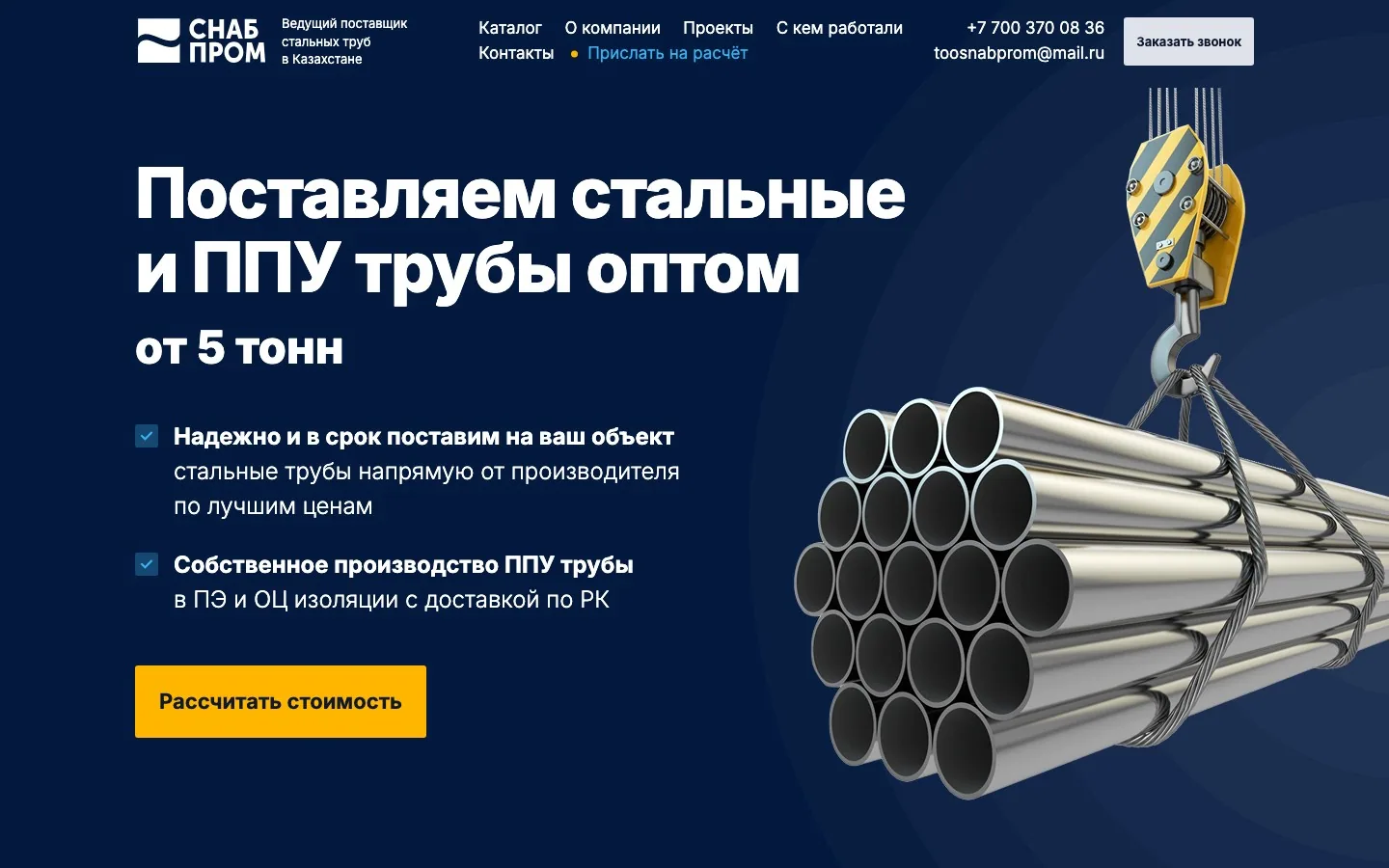
Wholesale steel pipes are one of the most competitive markets in Kazakhstan. Dozens of suppliers, established players with well-run operations and tenders decided by tiny differences in price per tonne. A website, advertising or CRM alone cannot win this market. They need to work together.
With Snab Prom, we went from the first website and 200 keywords to two specialised landing pages, 20 000 advertising keywords, end-to-end analytics and a CRM rebuilt after three well-known contractors. During that time, the client chose to triple the advertising budget.
The start: one website, one ad setup, one stream of enquiries
The first website combined steel pipes and PU-insulated pipes. Advertising used a standard keyword set, and all enquiries went into one stream. It worked, but there were two problems.
The first was retail. “Buy steel pipe” could come from a construction company buying 500 tonnes or an individual wanting two metres. Sales managers spent half their time qualifying enquiries instead of selling.
The second was that PU-insulated pipes were getting lost. In-house production, a 25-year warranty and contracts worth billions were buried on a general website alongside dozens of rolled steel products.
We collected five years of data: conversions, heatmaps and call recordings. Then we proposed separating the products.
Two landing pages, 20 000 keywords and a form that filters out retail
The split delivered what we expected: each landing page speaks to one audience. The PU page focuses on production, capacity and real contracts with their values. The steel page covers the product range, delivery speed and logistics.
Both have an “up to 5 tonnes” form. Retail enquiries go into a separate stream, so managers handle wholesale only. More than half of retail enquiries are filtered out on the website itself.
We rebuilt advertising alongside this. The initial keyword set contained 20 000 queries. Hundreds of groups: procurement specialists search one way, estimators another; some need GOST standards, others technical documentation. Each group gets its own ad. Long-tail queries have almost no competition, and clicks cost several times less.
Regions proved a challenge: southern Kazakhstan has different competition and logistics distances. We gave it a separate strategy.
Landing page conversion: 8% for steel, 15% for PU-insulated pipes. 80% of enquiries are calls, all linked to advertising campaigns through Ringostat.
CRM: three contractors before us, and why everything needed rebuilding
The hardest part of the project was Bitrix24, rather than advertising or the website.
Expensive, well-known contractors had configured the system before us. Technically, it pushed cloud Bitrix to its limits. It looked good on paper. In practice, we rebuilt or removed almost every business process, because they had been designed in a vacuum without understanding how people actually worked.
People worked with scraps of paper, Excel and WhatsApp. Resistance was constant, which is normal when changing habits built over ten years.
Sales pipelines, reports and document workflows turned out to be the easy part. Logistics was harder. It had its own world: specifications in spreadsheets, project documentation in spreadsheets and client orders in spreadsheets. That format was here to stay.
We worked with it and developed a Google app. Spreadsheets are generated automatically, with Bitrix24 acting as the tracker. When a client sends a spreadsheet order, one click transfers all items to a deal without manual entry. Documents are generated from the deal, and pipeline stages automatically assign tasks to departments.
Perfect? No. But now there are ways to measure, compare and find bottlenecks. Paper notes and message threads provide none of those controls.
A dedicated lead specialist: the decision that doubled conversion
The last piece of the puzzle was organisational. We spent a long time persuading the client to dedicate a person to incoming enquiries. In wholesale, 80% of enquiries are calls. If nobody answers, or the response is distracted, the buyer calls the next supplier. There is no second chance.
Once a dedicated lead specialist was in place, deal conversion doubled. The client chose to triple the advertising budget. We are now training algorithms on qualified wholesale orders, specifically enquiries that became deals rather than every incoming enquiry.
What applies to any B2B business
The same combination works in any business with a high average order value: a specialised website, in-depth keyword research, CRM with end-to-end analytics and a person responsible for handling enquiries. Remove any link and the system works at half strength. Bring all four together and the budget stops being just an expense.
If your wholesale business gets more retail than wholesale enquiries from advertising while managers work in Excel, get in touch. We will identify the weakest link in your system.