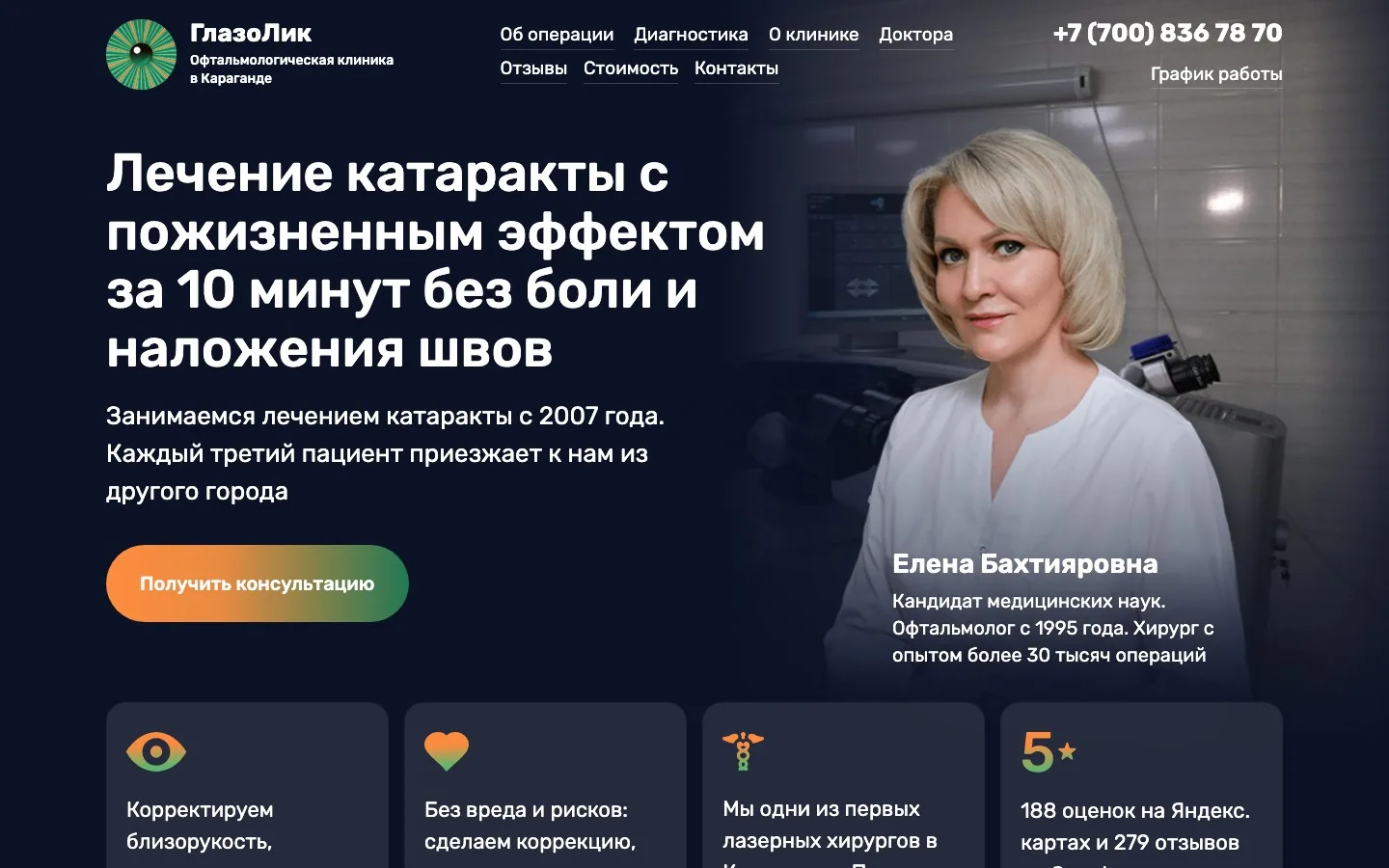
A 23% CTR is among the highest we have seen in healthcare. Yet the landing page conversion rate is lower than for LASIK: the audience is different, decisions take longer and the fears are different. Here is how the page works and why its high CTR is a predictable outcome.
The audience: two people involved in one decision
Cataracts are age-related. The main audience is people aged 55+. Yet they do not always search online themselves. Adult children or grandchildren often search on their behalf, worrying, comparing options and asking questions. That changes the approach to the page fundamentally.
We built the page for both: an older person afraid of surgery and unsure what will happen, and a younger relative who wants to know the clinic is trustworthy and treatment is safe for their mother or grandfather.
Older patients have specific fears
For older patients, fear of eye surgery comes with a specific concern: strain on the cardiovascular system. General anaesthesia is ruled out for many on health grounds. We addressed this directly: the procedure uses local anaesthesia in the form of eye drops.
The page makes this a separate argument: “Local anaesthesia is safer for older patients: it does not put strain on the cardiovascular system.” For the intended audience, this removes a major barrier.
Building trust with credible numbers
For older patients and their children, trust in the clinic comes first. Attractive design alone cannot provide it. Specific figures can:
- 30 000 operations — the surgeon’s experience. A specific figure makes “an experienced team” tangible.
- Since 2007 — among the first ophthalmic surgeons in Kazakhstan.
- 279 reviews on Google Maps, 188 ratings on Yandex Maps — verifiable figures supporting the claims.
- “Every third patient comes from another city” — social proof that gives people a reason to believe the journey is worthwhile.
Monofocal, multifocal, toric: explain what people are paying for
Cataract treatment offers several options with different features and prices, unlike LASIK. Monofocal lenses are the basic option; multifocal and trifocal lenses can remove the need for glasses after surgery; toric lenses serve patients with astigmatism. Each option is explained clearly, without medical jargon.
Understanding what makes up the price makes deciding easier. Lack of transparency in healthcare is a major source of anxiety.
The same examination-first principle as LASIK
As on the LASIK landing page, the first offer is an examination. This is especially important for cataracts: selecting the right lens requires a full assessment, while early diagnosis identifies other conditions that affect the treatment choice.
The examination costs 17 000 ₸ and takes 2 hours, including a full assessment and lens selection. Patients receive a report with recommendations so they can make an informed decision.
23% CTR, 5–6% conversion, a 7 500 ₸ lead: why cataract enquiries take longer
- Ad CTR — 23% — a record for the medical niche
- Landing page conversion — 5–6%
- Cost per lead — around 7 500 ₸ (~15$) through Google Search
- Conversion is naturally lower than for LASIK: patients are older, decisions take longer and involve the family
- Patients travel from Astana, Pavlodar and other regions of Kazakhstan
A principle for businesses serving older or cautious audiences
When a family makes the decision together, the page needs to speak to both generations. Specific figures (30 000 operations, since 2007, 279 reviews) build trust where design alone cannot. Transparent pricing reduces anxiety. An intermediate step such as an examination before surgery works even better with older audiences than younger ones, because the entry barrier is higher.